
As the Product Engineering Lead at Acquaint Softtech, a Mobile App Development partner, the question every mobility founder underestimates is this: the rider app is only half the product, so who is building the app your drivers live in for eight hours a day?
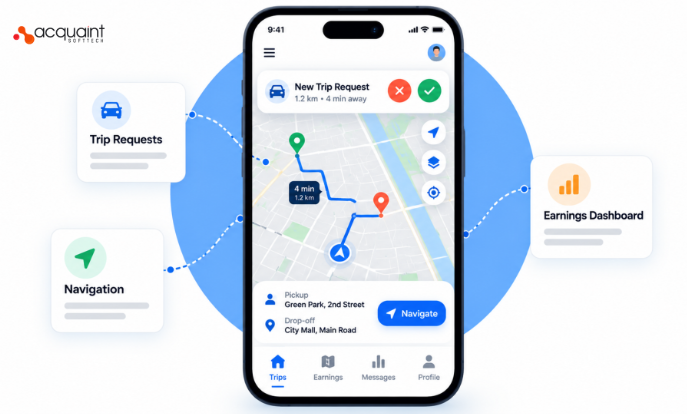
A driver app is the cockpit of a ride-hailing or delivery business. It has to surface trip requests in seconds, navigate reliably, show earnings a driver trusts, and keep working when the signal drops. This guide covers how to build each of those four pillars, plus the stack and cost behind them.
A driver app that lags, drains the battery, or hides earnings pushes drivers to a competitor overnight. The approach here draws on real field-facing apps Acquaint Softtech has delivered as an Official Laravel Partner, with 1,300+ projects, 70+ in-house engineers, and clients across the USA, UK, Europe, and Australia who get a dedicated team within 48 hours of a brief.
What a driver app needs to do
A driver app is the mobile control center a driver uses to receive work, navigate to it, complete it, and track what they earn. It has to do all of this quickly, on cheap phones, and often on weak networks.
The four pillars
Every serious driver app rests on four pillars: fast trip requests, reliable navigation, a clear earnings view, and offline resilience. Weakness in any one of them shows up as cancelled trips or churned drivers. Acquaint Softtech builds these four as the core, then layers extras like heatmaps and ratings on top.
Trip requests: the accept-or-decline moment
A trip request is the timed offer a driver sees when a rider books nearby, showing pickup, direction, and estimated pay before a short countdown. Getting this screen right is the single biggest lever on driver acceptance.
What a good request screen shows
| Element | Why it matters | Good practice |
| Pickup distance and ETA | Drivers judge if it is worth it | Show minutes, not just a dot |
| Trip direction | Drivers avoid dead-end areas | Show the general heading |
| Estimated earnings | Sets the accept decision | Show pay before the timer |
| Countdown timer | Keeps dispatch moving | 10 to 15 seconds, clearly visible |
A request that arrives late or hides the fare gets declined, which sends the trip back into the matching loop.
Turn-by-turn navigation that drivers trust
Navigation in a driver app means turn-by-turn guidance from the driver location to pickup, then to drop-off, updated live for traffic. Most apps embed a maps SDK rather than build routing from scratch.
Build vs embed
Building a routing engine is rarely worth it early. Embedding a proven maps SDK, such as Google, Mapbox, or HERE, gives drivers familiar directions and live traffic on day one. The real work is a smooth handoff: pickup navigation, then an automatic switch to drop-off once the rider is aboard.
The earnings dashboard drivers actually check
An earnings dashboard is the screen where a driver sees today’s pay, the week’s total, and a breakdown per trip. It is the number that keeps drivers on your platform, so it must be accurate to the cent and updated the moment a trip ends.
Trust comes from the breakdown
Drivers distrust a single lump sum. Show each trip’s fare, tips, bonuses, and deductions, and let them tap any day to see the trips behind it. A transparent breakdown cuts support tickets and, more importantly, keeps drivers from feeling shortchanged.
Offline mode: working with no signal
Offline mode lets a driver keep working through dead zones by storing actions on the device and syncing them once the network returns. Without it, a driver in a tunnel or a rural gap loses trip status, navigation, and earnings updates.
Queue locally, sync later
The pattern is a local queue: record trip events, status changes, and notes on the device, then replay them to the server when signal returns. Solid Backend Development with conflict-safe sync is what stops two versions of the truth from colliding when the phone reconnects.
The tech stack behind a driver app
A driver app is usually cross-platform to reach Android and iPhone drivers from one codebase. Cross-platform React Native App Development lets one team ship the driver app to both stores at once, which matters when drivers use a wide range of cheap devices.
What the pieces do
| Layer | Common choice | Job |
| App framework | React Native or Flutter | One codebase for Android and iPhone |
| Real-time channel | WebSocket or push | Deliver trip offers instantly |
| Navigation | Google, Mapbox, or HERE SDK | Turn-by-turn with live traffic |
| Local store | SQLite or MMKV | Hold data and the offline queue |
What it costs to build
The cost of a driver app depends on how many of the four pillars you build fully and whether navigation and offline sync are basic or robust.
| Scope | What you get | Typical range (USD) |
| MVP driver app | Trip requests, embedded navigation, basic earnings | $12,000 to $30,000 |
| Full driver app | Predictive requests, offline sync, detailed earnings, ratings | $30,000 to $70,000 |
Where the savings are
Ship trip requests, navigation, and a simple earnings view first, then add offline sync and richer analytics once real drivers are on the road. Acquaint Softtech staggers the build this way, running at up to forty percent cost savings versus Western agencies, with blended rates of roughly twenty-five to forty-nine US dollars per hour.
Proof: a field deployment platform we shipped
A driver app is, at its core, software that assigns work, routes a worker to it, and tracks status live from a phone. For Astound Broadband, a US internet provider, Acquaint Softtech built exactly that pattern for field technicians. The account below is drawn from the client’s 5.0 out of 5 Clutch review.
| Challenge | Solution | Result |
| Technician routes were coordinated by hand | Scheduling module that suggests optimized routes and assigns by location | Less unnecessary travel for field teams |
| Office and field lost time on handoffs | Real-time job status updates and en-route customer alerts | Faster deployment after a ticket opens |
| Work spanned desks, tablets, and phones | One platform optimized for desktop, tablet, and mobile | Smoother coordination during peak outages |
The build maps cleanly onto a driver app: assign the job, route the worker, update status live, and keep it usable on a phone in the field. CEO Jim Holanda said the team’s “ability to understand the complexity of our operations stood out”, which is the difference between an app drivers tolerate and one they rely on. Whether the worker is a technician or a driver, Acquaint Softtech builds the field experience around the person using it, not the office watching.
See also: Buy Registered Passports, drivers licenses, ID cards, Visas,etc
FAQs
What is a driver app?
A driver app is the mobile app that drivers use to receive trip requests, navigate to pickups and drop-offs, track earnings, and update trip status. It is the driver-side half of a ride-hailing or delivery platform, separate from the rider app.
How do trip requests work in a driver app?
When a rider books nearby, the driver sees a timed offer showing pickup distance, direction, and estimated pay, with a short countdown. Accepting locks the trip; declining or timing out sends it back to the matching engine for the next driver.
Do driver apps need offline mode?
Yes. Drivers regularly hit tunnels, garages, and rural dead zones. Offline mode stores trip events and status changes on the device and syncs them when the signal returns, so no trip or earning is lost when the network drops.
Should a driver app be built in React Native or native?
React Native or Flutter usually wins for a driver app, since one codebase reaches both Android and iPhone and speeds updates. Fully native makes sense only when you need deep, device-specific performance that a cross-platform framework cannot match.
How is the earnings dashboard kept accurate?
By updating it the moment each trip closes and showing a per-trip breakdown of fare, tips, bonuses, and deductions. Accuracy to the cent and a visible breakdown are what keep drivers trusting the total and cut down on support tickets.
How long does it take to build a driver app?
An MVP with trip requests, embedded navigation, and a basic earnings view usually takes a few months with a small team. Offline sync, predictive requests, and detailed analytics add time, since each depends on a solid backend underneath.