Newsletter Subscribe
Enter your email address below and subscribe to our newsletter

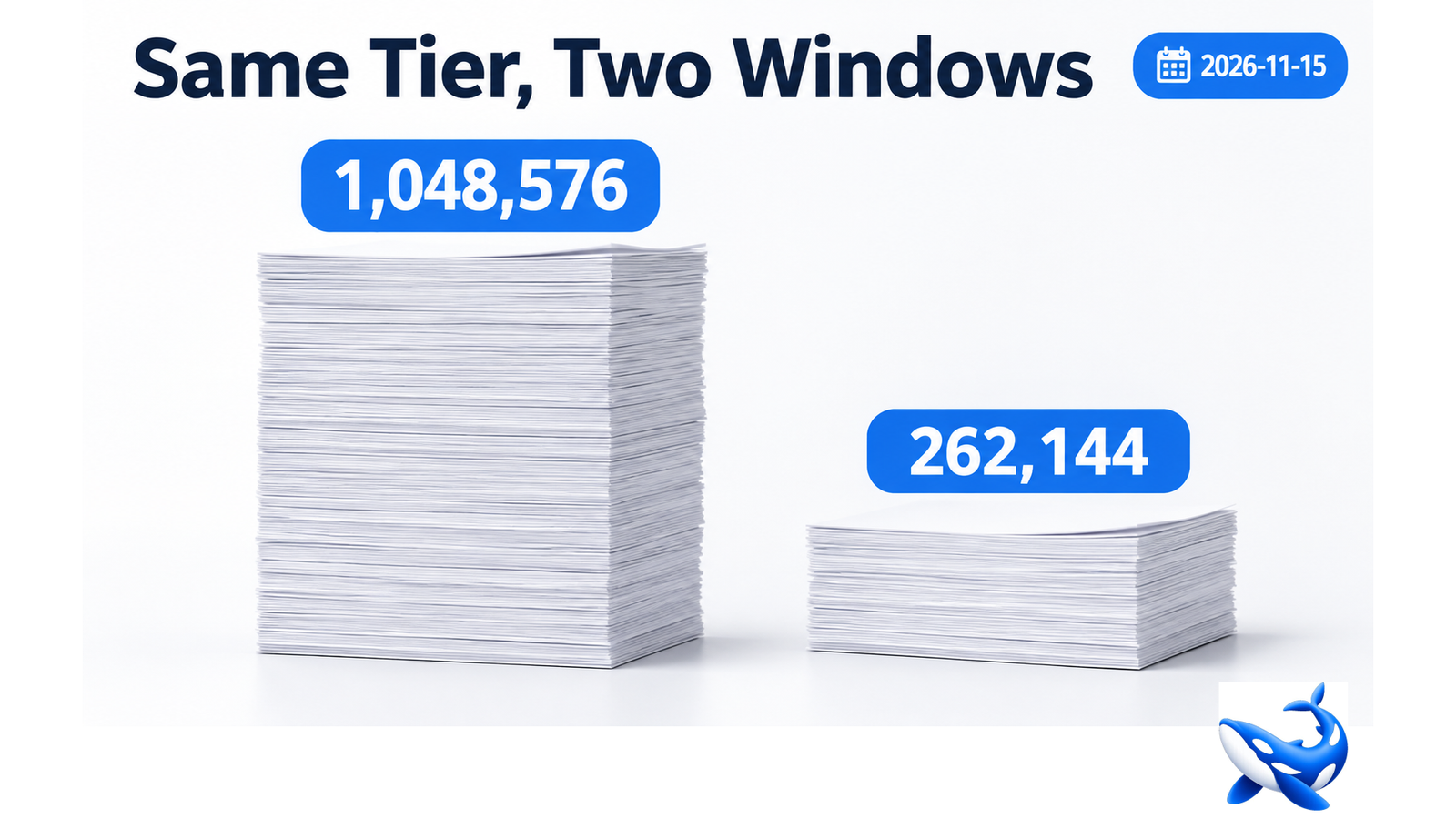
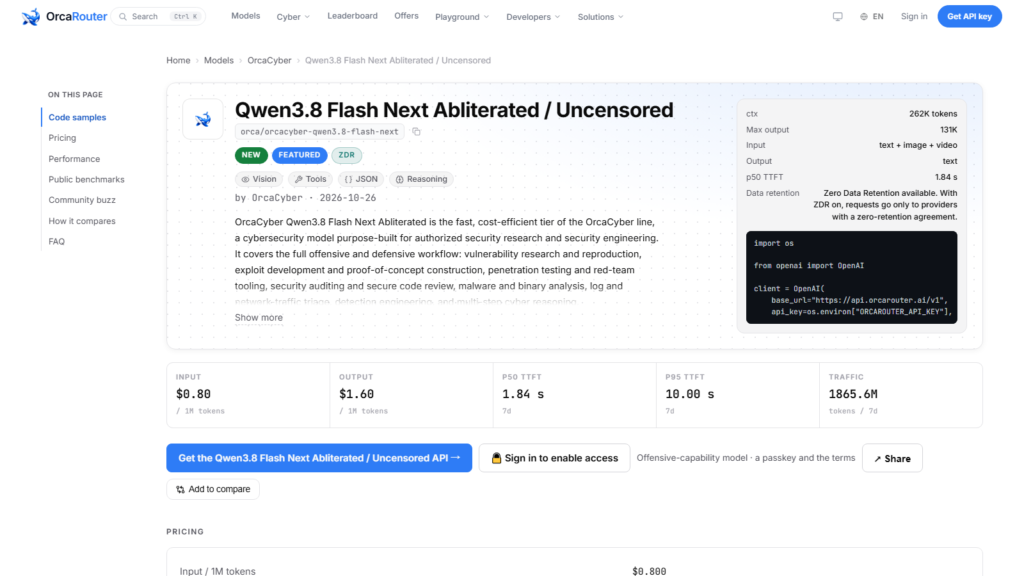
Nine of the eleven cards on OrcaRouter‘s cyber tier carry a window of roughly a million tokens. Two carry a quarter of that: Qwen3.8 Flash Next abliterated and MiniMax M3.1 Flash both cap at 262,144 [OURS].
The nine: DeepSeek V4.1 Flash at 1,048,576; Kimi K3.1 Pro at 1,048,576; GLM 5.3 Flash at 1,048,576; MiMo V2.6 Flash at 1,048,576; Hy4 at 1,048,576; GLM 5.3 at 1,000,000; Zero 1.0 and Zero 1.5 at 1,048,576; Ultra 1.0 at 1,048,576.
A 4× difference in the row that decides whether a job is possible at all is worth understanding, particularly because two of the four-times-smaller cards are among the tier’s best value on every other axis.
In source code, roughly 3,500 tokens per 1,000 lines for a language like Python, so about 75,000 lines — a mid-sized repository’s core, or a large module with its tests.
In prose, roughly 750 words per 1,000 tokens, so around 200,000 words — a stack of reports far larger than any single document a reviewer works with.
In logs, far less: a verbose application log is closer to 200 tokens per line, so 1,300 lines. That is a busy hour, not a day.
The three figures are the same number and they answer different questions. A window that is generous for code is tight for logs, and most security work is closer to the log end of that range than the code end.
Three places, and the first two are why the quarter-window cards are not the handicap they look like.
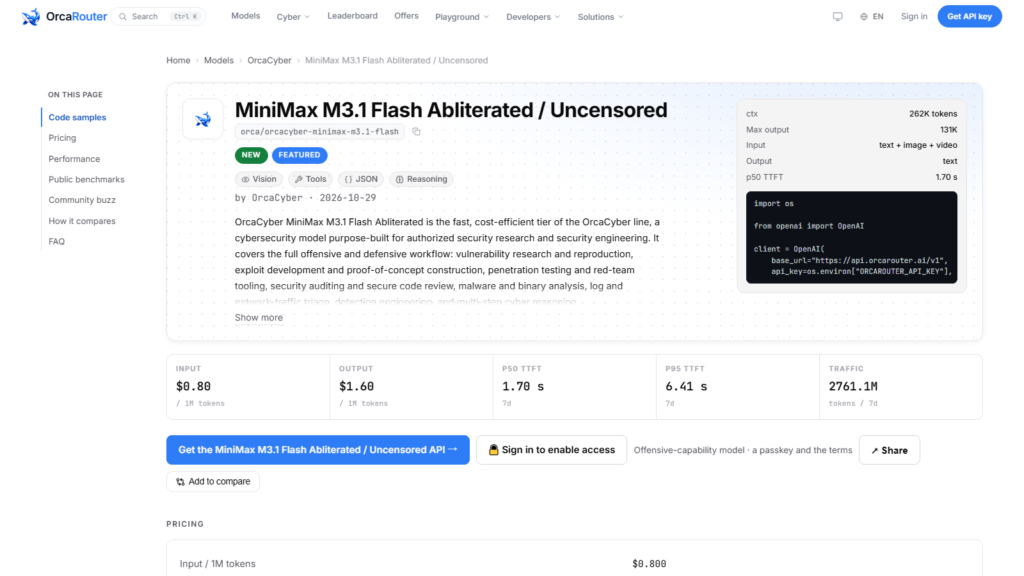
Cost. A million-token prompt at $0.80 per million input is $0.80 per call before any output. At MiniMax’s $0.15 base rate it is $0.15. Neither is free, and a pipeline that sends the whole repository on every call pays it every time.
Latency. Attention cost grows with context length, and the first-token latency on a long prompt is dominated by prefill. A card that answers in 998 ms on a short prompt does not answer in 998 ms on a million-token one.
Attention dilution. A model given a million tokens and one question has to find the answer among them. The published benchmark rows on these cards are measured on short prompts, so a window’s size is a capability limit rather than a measured capability.
The practical pattern that has emerged across this tier is a large cached prefix and a small working set: keep the repository summary in the prefix at 18.75% of the input rate, and keep the actual question short. That gets most of the benefit of a big window without most of the cost.
Both are strong on the rows that matter more often than window size.
MiniMax M3.1 Flash at 129.9 tokens a second, 0.272% errors, a 1,695 ms median and the flattest daily latency series in the tier [OURS]. For a triage pipeline over short documents it is the best card here on every serving row, and the 262,144 window is irrelevant to the work.
Qwen3.8 Flash Next at 94.0 tokens a second, 0.603% errors and 1,838 ms median, with text, image and video input and Toolathlon 73.5 in its inherited benchmark block [OURS, VENDOR for the row]. It is the cheapest video-capable card in the tier by a factor of five.
Neither card is a compromise on speeds and feeds. The window is the only row where they lose.
| if your job is | window | cards that fit |
| a whole repository at once | 1M | the nine |
| a module plus its tests | 262k | any of the eleven |
| a day of verbose logs | 1M | the nine |
| an hour of verbose logs | 262k | any of the eleven |
| a video walkthrough | 262k is enough | Qwen, Kimi, MiniMax, GLM 5.3 Flash, MiMo |
| a long agent transcript | 1M | the nine, or Kimi for its ceiling |
[OURS]. Video-capable cards are Qwen3.8 Flash Next, Kimi K3.1 Pro, GLM 5.3 Flash, MiMo V2.6 Flash and MiniMax M3.1 Flash.
The table resolves most choices, and the row that resolves the rest is the last one: a long agent transcript grows, and a card at 262,144 has less room for it than a card at a million.
Window and ceiling are different rows and conflating them causes most of the sizing errors on this tier.
MiniMax has a 262,144 window and a 131,072 ceiling [OURS] — half the window is available for output, which is generous.
Kimi has 1,048,576 window and 943,718 ceiling — ninety per cent of the window available for output, the most permissive ratio here.
Hy4 has 1,048,576 window and 65,536 ceiling — six per cent, by far the tightest [OURS].
A job that needs a large window and a large output is bounded by whichever row binds first. For most of the tier that is the ceiling, not the window.
Three options, in order of cost.
Split the job. A repository review that chunks by module costs a few seconds of orchestration and removes the window constraint entirely. It also improves the result, because each chunk gets focused attention.
Use the cache. A stable prefix on a small-window card is cached at 18.75% of input, so a repeated 200,000-token context costs $0.15 per million on Qwen against $0.80 fresh [OURS]. If the same large context is used repeatedly, a small window with caching beats a large window without.
Move the job to a large-window card. The nine at roughly a million tokens cost between $1.00 and $8.00 blended, so the move is a price decision rather than a capability one.
The first two are usually right. The third is right when the context genuinely cannot be split, which is rarer than the first draft of a design suggests.
Nine cards at roughly a million tokens, two at 262,144. The two small-window cards, Qwen3.8 Flash Next and MiniMax M3.1 Flash, are among the best on throughput, error rate and price.
Size the job before the window. Most security work fits in 262,144 once it is chunked; the cases that do not are usually better served by caching than by a larger window.
Check the output ceiling separately. On this tier the ceiling binds before the window on nine of the eleven cards.
Sourcing note: prices, cache rates, context windows, output ceilings, modalities, quality scores, latency, throughput, error rates and traffic are read from the eleven cards’ public model data on 2026-11-15, with seven-day windows ending that day [OURS]. Token-per-line and word estimates are our own approximations and are labelled as such. The Toolathlon row is OrcaCyber’s own [VENDOR].