Newsletter Subscribe
Enter your email address below and subscribe to our newsletter

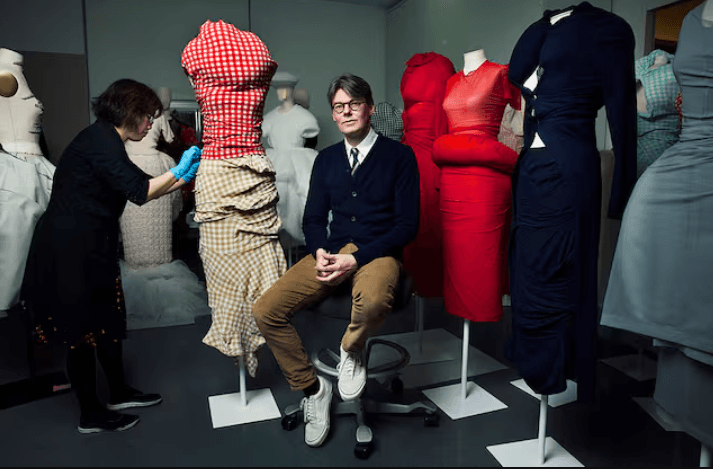
Comme des Garçons has a style that is difficult to describe with one simple phrase. The Japanese fashion house, founded by Rei Kawakubo, is known for unusual silhouettes, asymmetry, oversized garments, unexpected fabrics, and designs that question familiar ideas about clothing.
The label does not follow one permanent visual formula. A Comme des Garcons collection can be dark and sculptural, while another can use lighter fabrics, bright prints, or narrow silhouettes.
This constant change is part of the reason the brand remains interesting to fashion followers.
Rei Kawakubo approaches fashion by questioning what clothing can be.
Rather than beginning with a standard idea of how a dress, coat, or jacket should look, she can begin with shape, material, space, or the relationship between the garment and the body.
The Metropolitan Museum of Art describes her work as a repeated challenge to conventional ideas of beauty, fashionability, and the fashionable body.
This approach can make Comme des Garçons clothing look unfamiliar at first.
A coat might be much larger than the person wearing it. A dress might have an uneven outline. A jacket might hide the natural shape of the shoulders.
The clothes encourage the viewer to notice the garment itself.
Asymmetry is one of the strongest features of Comme des Garçons design.
A conventional garment often depends on balance. Both sides of a jacket may look almost identical. A skirt usually has a recognizable waist and hem.
Kawakubo often breaks these expectations.
One side of a garment may be longer than the other. Fabric can gather in unexpected areas. The opening of a garment can appear away from its normal position.
Palais Galliera describes the early Comme des Garçons collections as using loose and asymmetrical forms that differed sharply from Western fashion of the period.
Comme des Garcons often creates distance between clothing and the body.
Oversized coats, jackets, dresses, and skirts can make the body appear smaller or change its proportions. The clothing becomes a shape of its own.
This idea reached a notable point in the 1997 “Body Meets Dress—Dress Meets Body” collection.
The collection used padding and asymmetric forms to change the visual outline of the body. Palais Galliera records how the designs used stretch garments, geometric prints, and oversized padding to create distorted silhouettes.
The collection remains one of the most recognized examples of Kawakubo’s interest in the relationship between clothing and the human body.
Black has a long association with Comme des Garçons.
The early Paris collections made strong use of black and dark shades. The Met records the 1981 collection as using a consistent black palette along with oversized silhouettes and asymmetry.
Black works well with Kawakubo’s approach because it can reduce visual distraction. Without bright decoration, the viewer can pay closer attention to shape and construction.
The 1983–84 collection also used black and gray with oversized silhouettes and asymmetrical details.
Still, Comme des Garçons should not be reduced to black clothing. Later collections explored many different colors, materials, prints, and shapes.
The house has produced many collections that have become part of fashion history.
The early 1980s remain especially important because this was the period when Kawakubo introduced her ideas to a wider Western audience.
The spring/summer 1991 collection, “Ink Dye, Stained Glass,” provides a useful contrast. The Met notes that the collection moved away from the oversized silhouettes, consistent black palette, and intentionally damaged appearance associated with parts of the 1980s.
Instead, Kawakubo used chiffon, mousseline, stretch synthetic materials, and long narrow silhouettes. Some garments featured imagery inspired by stained glass from French cathedrals.
This collection shows that Comme des Garçons has never depended on one fixed appearance.
Comme des Garçons is often linked with anti-fashion because of its rejection of familiar fashion conventions.
The early 1980s collections challenged the idea that clothing should always look polished, fitted, decorative, or traditionally feminine.
The Met describes Kawakubo’s 1983 work as anti-fashion and notes how the collection questioned definitions of beauty and ugliness.
The point was not simply to make clothes look strange.
The clothes created a conversation about why certain shapes are considered attractive while others are rejected.
That question remains relevant because fashion constantly changes its definition of what looks desirable.
See also: How Artificial Intelligence Works in Everyday Life
Comme des Garçons helped bring greater international attention to Japanese fashion during the 1980s.
Kawakubo presented her first Paris collection in 1981. Yohji Yamamoto also presented in Paris that year. Palais Galliera describes their work as a challenge to Western ideas about dress, with loose shapes, asymmetry, muted colors, and black clothing.
Their Paris appearances helped introduce international audiences to a different approach to fashion design.
Japanese designers were no longer viewed only through traditional Japanese clothing references. They could create completely new approaches to shape, construction, and presentation.
The Metropolitan Museum of Art gave Comme des Garçons major recognition through its 2017 exhibition devoted to Rei Kawakubo.
The exhibition presented approximately 140 examples of her womenswear and organized the work around nine themes.
These included “Absence/Presence,” “Design/Not Design,” “Fashion/Anti-Fashion,” “High/Low,” and “Clothes/Not Clothes.”
The structure of the exhibition shows why Kawakubo’s work attracts serious attention.
Her clothing often exists between familiar categories. A garment may look like clothing but also resemble sculpture. A dress can conceal the body rather than decorate it. A simple black piece can carry more visual meaning through its shape than through ornament.
Comme des Garçons can be worn in everyday outfits without copying a runway look.
One unusual piece can become the main part of an outfit. A large jacket can work with simple trousers. An unusual shirt can be paired with jeans. A sculptural skirt can be balanced with a plain top.
The main idea is to let the unusual garment have room.
Too many competing pieces can make the outfit difficult to read. Simple accessories and quiet colors can help a distinctive Comme des Garçons item stand out.
Comme des Garçons has grown far beyond its original womenswear label.
The company now includes menswear and multiple clothing lines, along with accessories, fragrances, footwear, and other products. The Federation de la Haute Couture et de la Mode lists menswear as part of the house since 1978 and notes that Rei Kawakubo continues to oversee the company.
The brand also has a strong presence in fashion retail and cultural spaces.
Its influence can be seen in the way modern designers approach proportion, gender, clothing construction, and the relationship between fashion and art.
Comme des Garçons remains interesting because it does not give viewers one simple answer.
Its clothes can be beautiful without being traditionally pretty. They can be simple without being ordinary. They can look strange while still being carefully designed.
Rei Kawakubo’s work encourages people to question the assumptions behind clothing.
That is perhaps the strongest reason Comme des Garçons continues to matter. The label does not only sell garments. It presents different ways of thinking about shape, beauty, the body, and personal style.
For anyone interested in Japanese fashion, avant-garde clothing, fashion history, or Rei Kawakubo, Comme des Garçons offers a rich subject with decades of collections to study.