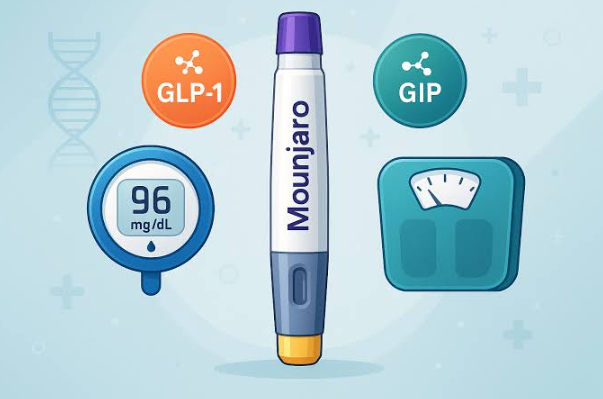

Peptide research has changed significantly as scientists have learned more about the different signalling pathways involved in metabolism. One compound that has attracted particular attention is tirzepatide, a peptide designed to interact with two important hormone receptors rather than focusing on just one.
This dual-action approach is one of the main reasons tirzepatide is frequently discussed alongside other well-known peptides such as semaglutide and newer research compounds such as retatrutide.
But what exactly makes tirzepatide different?
The answer starts with two naturally occurring hormones: GLP-1 and GIP.
What Is Tirzepatide?
Tirzepatide is a synthetic peptide that acts as an agonist at both the GLP-1 and GIP receptors.
GLP-1 stands for glucagon-like peptide-1, while GIP stands for glucose-dependent insulinotropic polypeptide. Both are naturally occurring hormones known as incretins, meaning they play important roles in the body’s response to food and changes in blood glucose.
Researchers have been interested in incretin signalling for decades. GLP-1 receptor agonists provided one approach to studying this system, while tirzepatide introduced an additional GIP component.
This is why tirzepatide is commonly described as a dual agonist or dual-action peptide.
Rather than looking at GLP-1 signalling on its own, researchers can investigate what happens when GLP-1 and GIP receptor activity are targeted by the same molecule.
See also: How Artificial Intelligence Works in Everyday Life
Understanding the GLP-1 Connection
To understand tirzepatide, it helps to first understand why GLP-1 became such an important research pathway.
GLP-1 is involved in several biological processes associated with glucose regulation, insulin secretion, appetite signalling and gastrointestinal function. GLP-1 receptor agonists were developed to mimic some of the effects associated with natural GLP-1 signalling while providing a longer-lasting effect.
Semaglutide is one well-known example of a GLP-1 receptor agonist.
Tirzepatide peptide also activates the GLP-1 receptor, but it does not stop there. Its ability to interact with the GIP receptor is what gives the compound its distinctive research profile.
This makes tirzepatide particularly interesting when researchers want to investigate how multiple incretin pathways interact.
So What Is GIP?
GIP is sometimes less familiar to people outside peptide and metabolic research.
Glucose-dependent insulinotropic polypeptide is another hormone released in response to food. Like GLP-1, it is involved in the regulation of insulin secretion and broader metabolic processes.
The scientific interest in GIP has grown as researchers have explored whether targeting GIP and GLP-1 pathways together can produce different biological responses compared with targeting GLP-1 alone.
That question is at the heart of much of the interest surrounding tirzepatide.
Instead of thinking of GIP as simply an additional ingredient, it is more useful to think of it as another signalling pathway that may interact with GLP-1 in complex ways.
Why Is Dual Agonism Interesting?
The concept of targeting two receptors with one peptide is not entirely new. However, tirzepatide has become an important example of how researchers can design molecules around more than one biological pathway.
A simple comparison helps explain the idea:
Semaglutide: primarily GLP-1 receptor activity
Tirzepatide: GLP-1 and GIP receptor activity
Retatrutide: GLP-1, GIP and glucagon receptor activity
These differences do not mean that one compound is automatically “better” than another. They represent different pharmacological approaches and therefore different research questions.
For researchers, the interesting part is understanding what changes when another receptor pathway is introduced.
Tirzepatide and Modern Peptide Research
The development of tirzepatide reflects a broader trend in peptide research: moving beyond single-receptor approaches.
For many years, researchers focused heavily on individual hormone pathways. As understanding of metabolic biology improved, interest expanded towards combinations of pathways that naturally interact with one another.
Tirzepatide provides an example of this approach.
Researchers can investigate questions surrounding receptor activation, signalling, pharmacokinetics and interactions between GLP-1 and GIP pathways. These questions can be explored at different levels, from molecular biology to broader physiological research.
This also helps explain why tirzepatide frequently appears in discussions about the next generation of peptide research.
How Is Tirzepatide Different From Semaglutide?
The easiest distinction is receptor activity.
Semaglutide is designed to activate the GLP-1 receptor, whereas tirzepatide activates both GLP-1 and GIP receptors.
That difference may sound simple, but receptor biology is rarely simple in practice.
Adding another receptor target can influence the overall pharmacological profile of a molecule. Researchers therefore cannot assume that the effects associated with semaglutide will simply be reproduced by tirzepatide.
The two compounds have different molecular structures and pharmacological characteristics, which is why direct comparisons need to consider more than receptor names alone.
For people new to peptide research, this is an important distinction. Two compounds can belong to the same broad research area while still behaving differently.
How Does Retatrutide Take the Idea Further?
Retatrutide provides another useful point of comparison.
While tirzepatide targets GLP-1 and GIP receptors, retatrutide is designed to interact with GLP-1, GIP and glucagon receptors. This makes it a triple agonist rather than a dual agonist.
The addition of glucagon receptor activity introduces another biological pathway and creates a different research profile.
This progression from one pathway to multiple pathways is one of the reasons modern peptide research is so interesting.
It also demonstrates why researchers need to look beyond simple labels such as “GLP-1 peptide”. The receptor profile can tell us much more about what a compound is designed to investigate.
What Should Researchers Consider When Working With Tirzepatide?
Understanding the compound is only one part of conducting good peptide research.
Researchers may also need to consider the quality and consistency of the material being studied. Purity, identity, batch information and analytical documentation can all be relevant when evaluating research peptides.
A certificate of analysis can provide useful information about a particular batch, although researchers should review what tests were performed, which analytical methods were used and what the reported results actually demonstrate.
Sourcing is another consideration. UK suppliers such as British Peptides may provide documentation and batch information that researchers can review when assessing research materials.
The important principle is to base experimental decisions on documented information rather than relying solely on product descriptions or general claims found online.
Why Documentation Matters
Peptide research can involve very small differences between experimental conditions. If the material being studied is inconsistent from one batch to another, it can make interpreting results more difficult.
Good documentation can help researchers understand what material was used and establish greater consistency between experiments.
This is particularly relevant when working with compounds that are frequently discussed online. A product labelled “tirzepatide” does not, by the name alone, tell a researcher everything about its identity, purity or analytical characterisation.
The same principle applies to semaglutide, retatrutide and other research peptides.
Is Tirzepatide the Same as a GLP-1 Peptide?
Not exactly.
Tirzepatide is often grouped into conversations about GLP-1 peptides because GLP-1 receptor activity is one part of its mechanism. However, describing it simply as a GLP-1 peptide misses its GIP activity.
This distinction is more than a technical detail.
The dual mechanism is central to why tirzepatide is scientifically interesting and why it is frequently compared with both GLP-1-only compounds and newer multi-receptor candidates.
For readers following peptide science, understanding this terminology makes it much easier to evaluate discussions about different compounds without confusing their mechanisms.
The Growing Interest in Multi-Pathway Research
The interest in tirzepatide forms part of a much larger movement in peptide science.
Researchers are increasingly investigating whether interacting with multiple biological pathways can provide new insights into metabolic regulation. Some compounds focus on one receptor, others combine two, while newer candidates are being designed around three or more pathways.
This does not mean that multi-receptor compounds should automatically be considered superior. Instead, they give researchers additional tools for investigating complex biological systems.
Tirzepatide sits in an interesting position within this development because it provides a well-known example of dual receptor activity.
For researchers evaluating peptide materials, companies such as Pure Peptides UK can be another source to investigate when comparing sourcing options, documentation and research-use information.
The Bigger Picture
Tirzepatide is interesting because it demonstrates how peptide research is moving beyond a single-pathway approach.
Its activity at both the GLP-1 and GIP receptors gives researchers an opportunity to study how two related metabolic signalling systems interact within one compound. This makes it a useful point of comparison with GLP-1-focused compounds such as semaglutide and triple-agonist candidates such as retatrutide.
The broader lesson is that understanding a research peptide requires more than knowing its name. Looking at its receptor profile, molecular characteristics, pharmacokinetics and available analytical information provides a much clearer picture of what researchers are actually studying.
As peptide science continues to develop, dual- and multi-receptor compounds are likely to remain an important area of investigation.
Research disclaimer: This article is intended for general educational and research-information purposes only. It is not medical advice and does not provide treatment recommendations or dosing instructions. Tirzepatide and other research compounds should be evaluated and handled in accordance with applicable laws, laboratory procedures, supplier documentation and appropriate professional standards.