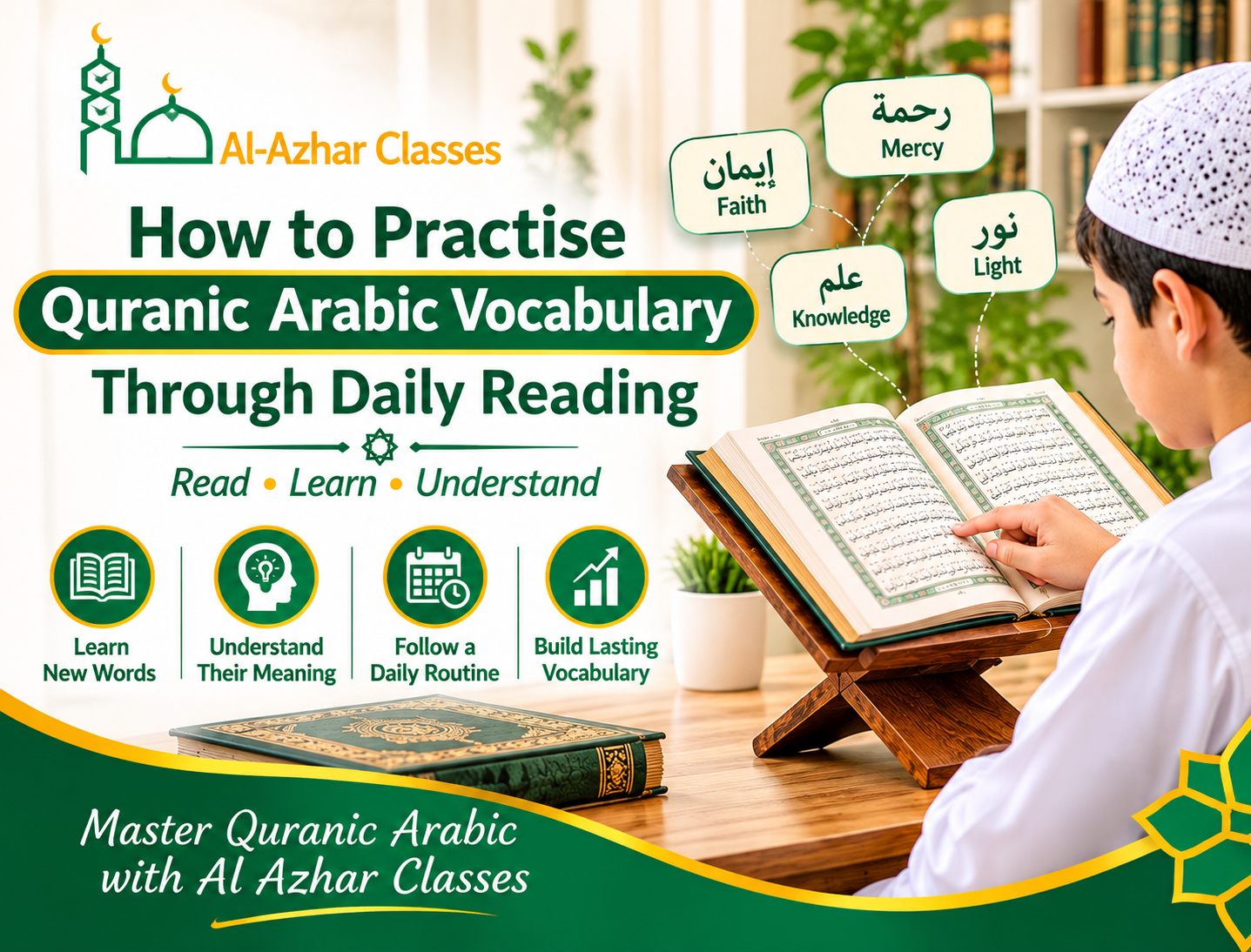

You can read a page of the Quran every morning and still not know what most of its words mean.
That gap between reciting and understanding is common, and a small daily habit closes it.
If you want to learn Quranic Arabic vocabulary through daily reading, you need a routine short enough to keep and tied to verses you already recite.
Al Azhar Classes teaches Quranic Arabic online with live tutors, and the method below follows what tends to work: small portions, read in context and reviewed on a schedule. This guide covers what the numbers say about Quranic vocabulary, a daily routine you can start today, the obstacles learners meet, and the tools worth using. For a wider overview of the subject, read this Quranic Arabic guide.
Why Quranic vocabulary is easier to build than it looks
The Quranic Arabic Corpus, created by Kais Dukes at the University of Leeds, counts about 77,430 words in the Quran. That number shrinks quickly once you account for repetition, because Arabic builds many words from a small set of roots. Dukes has pointed out that a handful of words, such as the 100 most frequent, cover a very large share of the text.
The figures worth knowing:
- About 77,430 words in total, counted as space separated word forms
- Roughly 1,700 unique roots, the three letter bases that most words grow from
- The preposition من (min, “from”) is the most frequent lemma, appearing 3,226 times
- Popular frequency lists put the 300 most common word forms at around 70 to 80 percent of the text, though the exact share changes with how words are counted
- 114 surahs in 30 parts, with most of the short surahs gathered in the final part
The most frequent lemma deserves a second look. Spread across the 604 pages of a standard mushaf, 3,226 appearances means you meet min more than five times on an average page. The same logic applies to the other very common words, so the first weeks of study repay you fastest when you begin with them.
Pew Research Center estimates about 1.9 billion Muslims worldwide, and most do not speak Arabic as a first language. For most readers, then, vocabulary has to be built on purpose. Repetition helps: common words return again and again, so early effort pays off quickly.
Build the habit around one small portion
Choose a portion you can finish in twenty minutes, such as one to three verses or one short surah. Many beginners start with Juz Amma because its surahs are short and often familiar from prayer. Surah Al Ikhlas has four verses and Surah Al Kawthar has three, so either fits easily into one session.
If you cannot yet read Arabic letters smoothly, begin with the Arabic alphabet first. Reading letters slowly leaves little attention for meaning.
A sample twenty minute session looks like this:
- Minutes 1 to 3: read yesterday’s portion aloud and spot the words you already know
- Minutes 4 to 8: read today’s portion aloud, paying attention to Tajweed
- Minutes 9 to 15: pick three to five new words and study each one
- Minutes 16 to 20: review word cards from earlier days
Learn each new word through its root
Learning isolated words by rote wears out fast. Learning the root first lets one entry open several words.
Take Surah Al Fatihah. Ar Rahman and Ar Rahim both come from the root ر ح م, which carries the idea of mercy. Once you know that, rahma (mercy) is no longer a new word when you meet it in other surahs.
For every word, record four things:
- The Arabic word with its vowel marks
- The root and its core meaning
- A short meaning from a trusted translation or word list
- The verse where you met it
A Quran word by word layout places the translation, and often the root and grammar, under each word, which makes this step faster. Keep your cards grouped by root, so Rahman, Rahim, and rahma sit together as one family.
Space your reviews
A 2006 review in Psychological Bulletin by Nicholas Cepeda and colleagues covered 317 experiments on spaced practice. Across verbal memory tasks, spreading study sessions out generally supported retention better than packing them into one sitting.
An easy schedule to adapt:
- Review new words the next day
- Review them again after three days
- Review them after one week
- Then check them once a month
The right gaps vary from person to person, so lengthen the interval for words you always remember and shorten it for words that slip. If your week is crowded, these ideas on how to study the Quran regularly with a busy schedule can help you protect the habit.
Tools and trends worth using
Learners now have tools that earlier generations did not. Word by word displays show the grammar of each term, frequency ordered lemma lists such as the one at corpus.quran.com tell you which words to learn first, and spaced repetition apps like Anki schedule reviews automatically.
Tools have limits. They cannot hear your pronunciation, and they cannot explain why a word shifts meaning from one verse to another. A live online Arabic tutor can correct your recitation, explain context, and review your word list each week. If you prefer a structured path, the online Quranic Arabic course at Al Azhar Classes gives background on each surah, then interactive pages where you can click a word to hear it and see its translation.
Common challenges and how to handle them
- Context changes meaning: Many Quranic words take a sense that depends on the verse, so consult a reliable tafsir before settling on a meaning.
- Leaning on translation: Guess a word from its root and the surrounding verse first, then check the translation.
- Modern Arabic habits: A word can carry a different sense in Classical Arabic than in modern usage, so rely on Quran specific resources.
- Forgotten words: Missed reviews pile up quickly, so cut new words to two or three on busy days.
- Burnout: Cap new words at five a day. At that pace, 300 words take about two months.
- Pronunciation drift: Reading alone lets small errors settle in, so record yourself or ask a teacher to listen.
Quick tips for daily reading
- Read the same portion for several days before moving on, so words repeat in the same context
- Listen to a skilled reciter, then read along aloud
- Say the root aloud each time you review a word
- Mark words you recognise with a coloured pen, and count them weekly
- Tie the session to a fixed moment, such as after Fajr
- Write one line in your own words about what each verse says
Frequently Asked Questions (FAQs)
1. How many words do I need to understand the Quran?
Start with the most common Quranic words instead of a full dictionary. Popular frequency lists put the 300 most frequent word forms at roughly 70 to 80 percent of the text, though counts vary by method. At five new words a day, that takes about two months. For a longer roadmap, see how to learn Arabic online in six months.
2. How long should daily Quran reading take for vocabulary practice?
Twenty minutes is enough. Read your portion aloud, study three to five new words, and review cards from earlier days. Short daily sessions usually work better than one long weekly session, and these Tajweed tips for reading at home keep your recitation accurate.
3. Can a beginner learn Quranic Arabic vocabulary without knowing Arabic?
Yes, once you can read the letters. Begin with the alphabet, then the most frequent words, then roots. Most Muslims are not native Arabic speakers, so many learners start exactly here, and a course in Arabic for beginners is a good place to begin.
4. Why is learning words by root better than learning them one at a time?
One root opens several words. The root ر ح م, for example, links Ar Rahman, Ar Rahim, and rahma, so a single card covers a whole word family. For more on studying vocabulary inside the verses themselves, read about learning Arabic through the Quran.
5. How often should I review new Quranic words?
Review them the next day, after three days, after one week, and then monthly, adjusting the gaps to your memory. A 2006 review of 317 experiments in Psychological Bulletin found that spaced study generally supports retention of verbal material better than cramming. Your tutor can help set those gaps, and here is how to get the most out of your online Quran tutor.
6. Is Quranic Arabic different from modern Arabic?
They are related but not identical. The Quran is written in Classical Arabic, and some words carry a different sense there than in modern usage, so rely on Quran specific resources and a reliable tafsir. If you want to study both, an Arabic course for non native speakers is a sensible next step.
Turning daily reading into a growing vocabulary
Vocabulary grows from regular contact with verses you already read. Choose a small portion, learn each word through its root, review on a schedule, and check meanings against reliable sources. At five words a day, you can work through 300 of the most frequent words in about two months and keep building from there.
Al Azhar Classes supports this routine with verified tutors and flexible one to one lessons for learners at every level. When you are ready to add guidance to your daily reading, register with Al Azhar Classes and book lessons with a teacher who can review your progress.